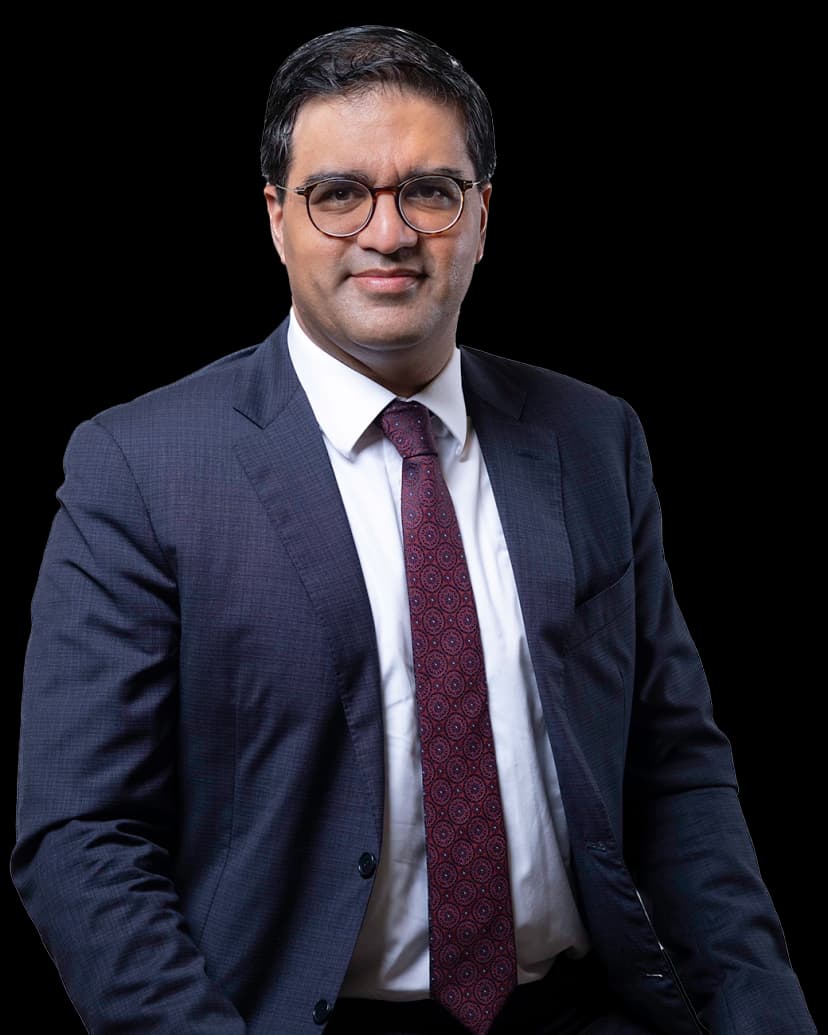
Aarij S. Wasti
Partner
Entertainment & Sport / Brand Protection, Corporate Commercial, Funds and Private M&A


Vidéos
Episode 4
As the world prepares for the FIFA World Cup 2026 across Canada, the U.S., and Mexico, Sideline Conversations takes you beyond the pitch to explore the legal and commercial issues shaping the tournament. Hosted by Aarij S. Wasti (Gowling WLG, Toronto), Marlon Hill (WSHC+B, Miami), and Juan Carlos Partida (EC Rubio, Mexico City), your cross-border legal guides to the world's biggest sporting event.
In Episode 4, they break down the live draw and what it means for teams and supporters across North America, emphasizing why cultural competence will be key to the fan and host-city experience. The hosts also highlight some of the challenges facing the upcoming tournament—from group dynamics and match expectations to travel logistics, ticketing hurdles, marketing strategies, and the impact of dynamic pricing on fan access.
Watch the full conversation below.
MARLON HILL: Here we go, here we go, here we go.
JUAN CARLOS PARTIDA: Good morning, Clutch. Good morning, Maple, my silent conversation brothers. This is Zayu from Mexico City. We're less than 90 minutes from the beginning of the World Cup draw, so we're really excited to know who Mexico is going to play next year.
AARIJ S. WASTI: Well, good morning to you from the 416, Clutch, Zayu. Good to see you guys. Truly historic day. Truly historic day. I think a draw that's been a long time coming, a lot of anticipation here. They've been wanting to host the tournament for a long, long time. The 13 matches are going to be a blockbuster. No doubt. This is the World Cup at the end of the day. There's no easy path. As Zayu said, you got to win it all to be the best.
And I think every team is hungry. I don't think there's an underdog. I know that the odds favor one team or the other, but this is going to be fun. We're going to have a blast. It all kicks off today. I got the Trionda ready. I look forward to hearing from you, as well, Clutch, as we take this forward.
MARLON HILL: Welcome once again back on the sideline. What we just witnessed are the live historic draw of 48 teams. Very first three-nation hosting. Just first, what is your emotion? What's your reaction on this historic draw?
AARIJ S. WASTI: JC.
JUAN CARLOS PARTIDA: Oh, it's a historic draw. As you mentioned, there are 48 teams in the draw. Everybody got selected. We have some tough schedules or tough groups, others not so much. But the one thing that stood out from this draw was the presence of the president of the US, the first minister of Canada and the president of Mexico. It's an historic moment, the three individuals there. It was very nice.
I was just telling Arch that Mr. Infantino may be also considered a precedent of a very, very large country because he was so familiar with them, even taking his selfie with them. It's an historic, historic day. It was really, really nice.
MARLON HILL: Well, being FIFA president is almost like being a secretary general of an extraordinary United Nations. You have to know your constituents, right, Maple?
AARIJ S. WASTI: Yeah, so I think this very much was sort of a preface for a bit of a summit. So the politics aside, I think it was done to a grand scale, nothing short of what you would expect in the United States. Whilst there were a number of Spanish-speaking guests that were interviewed, I did find that the presence on stage was lacking. There was no Mexican talent, as far as I could tell. And I received a number of messages saying that there's a little bit of an imbalance there.
And does this indicate what's to come in the tournament? I.e., this is a US tournament, and Mexico and Canada are a little bit on the sidelines. But it was a blockbuster event for sure.
MARLON HILL: Yeah, I kind of felt that, as well, like it was a little bit of an Americanized version, including the special guests who were the draw celebrities, as well. But certainly, it is on the soil of the United States. It's at the Kennedy Center. And Infantino has extended himself, I believe, to ingratiate the president and to do what's necessary to make sure that his runway is clear for hosting. So you can't really short him for doing that.
But certainly, the magnitude of football certainly overplayed. You could hear the "oohs" and the "ahs" and the live watching audience of the Doral Central Park, lots of Colombians, lots of South Americans that were in my live venue. And that certainly added to the drama, because many of those teams were in part 1 and part 2. But certainly, there are some surprises in the draw, geopolitically. Very interesting dynamics.
What's your first emotion? Is there a group that jumps out at you, JC, that emotionally grabs you in the corazon?
JUAN CARLOS PARTIDA: Well, obviously, group A where Mexico is playing, there's going to be-- we're going to have a inaugural game, which is going to be a repeat game from South Africa, which is going to be Mexico-South Africa first, the inaugural game. That's pretty much the group that draws my attention. But certainly, there is no clear death group or group of death. But I was looking at the groups, and I think the group that is comprised of France, Senegal, Norway, and the winner of the playoff 2, that's certainly going to be a tough group.
Norway, Senegal and France, that's going to be an interesting group. Other than that, a very interesting match. Brazil-Morocco, that's going to be a very interesting match, having Morocco play playing as well as they're doing. And Brazil, that's going to be an interesting match.
MARLON HILL: Listen, I'm enjoying a very nice Hatian lunch here post-draw here at a Haitian restaurant. And the Haitians across the world since 1804 have been waiting for this match, waiting for this match between Haiti and Brazil. That's going to be quite a moment for them. To be playing in that group, given all that they're going through right now, I think it's also going to be a special moment for them, as well.
JUAN CARLOS PARTIDA: Yeah, yeah.
AARIJ S. WASTI: Yeah, I agree with that. I think group C with Brazil, Morocco, Scotland, and Haiti, I agree it's not a group of death, but I think that there's a lot of significant and interesting matches there. I think Argentina won this draw full out, outright. They got a pretty easy draw, and with this sort of old Club World Cup format of brackets and not being able to meet top seeded teams, meeting each other until the semi-finals or the final, I think Argentina fared pretty well.
And then, of course, for me personally, the significance of Qatar coming to Canada is fantastic. We were in Qatar when Canada visited, and now it's the other way around. Already a number of messages on the groups of friends looking forward to visiting Toronto and Vancouver. So some fun there.
JUAN CARLOS PARTIDA: Some comments I was reading earlier were regarding the playoff teams, I think FIFA. And I agree, FIFA has to do something to have the whole group of participants already selected or already in this draw. Because certainly, all the groups that have one of those possible countries, they are in a bit of a disadvantage on preparing themselves to play against these teams, because they don't know who they are going to face until the end of March, perhaps.
So even though they have two, three months to prepare, I know it's not an excuse. But I think it would be nice to see that Mexico is playing Italy, for example, or Ireland. It's not going to be Italy. It may be Ireland, for example.
AARIJ S. WASTI: But JC, it goes beyond that. Like we talked about before, even the selection of the team base camps and the team base camp hotels. You can't lock in until you've actually qualified for the tournament. So it comes down to the same principle. The earlier you qualify, the easier it is. The later you qualify, the more difficult it is. And we've seen that even in Japan-Korea in 2002 with Ireland.
JUAN CARLOS PARTIDA: But there are regions, like our region CONCACAF, that it's becoming less easy to qualify every year. But it's certainly easier than in Europe, for example. So I think there has to be some changes. But overall, I think the draw was very interesting.
AARIJ S. WASTI: Now, we seem to have, Marlon, very different experiences today. You were at a watch party, so it would be great to hear a little bit about the atmosphere. JC was in and out of meetings and on the highway. He actually listened to the draw on the radio in Mexico, which is totally unexpected. And while I went around the city and took a look around, I decided, ultimately, to hide from the cold and watch it with my wife in our basement.
MARLON HILL: Well, listen.
AARIJ S. WASTI: Let's hear about the watch party.
MARLON HILL: You would have definitely enjoyed our environment, 79 degrees in the middle of Miami Dade County.
AARIJ S. WASTI: Stop mentioning the weather. We can skip over that.
MARLON HILL: Holding a cocktail, enjoying the bilingual broadcast with Telemundo, which was a very interesting Spanish and English-- the Spanish was overplaying the English in the Telemundo broadcast because they're a sponsor and they're going to be hosting. So that was interesting. No subtitles. But for those people who are bilingual, they were able to handle it. For the folks who were not, they had to listen very intently.
And I enjoyed Heidi Klum and Kevin Hart. I thought that dynamic was fun in terms of his size and her-- compared to her. I thought it was very interesting, and I think it was also a nice touch to have the legends of the other American sports, which went into play in the fact that this has been really hosted by the United States. And Canada and Mexico are adding a little fashion to the dinner table.
JUAN CARLOS PARTIDA: Yeah, I like Rio Ferdinand being the leading guy, but I think it could have been a Mexico-Canada sports star or soccer star doing that. I love Rio Ferdinand. I think he was a great, great player. But I think being in North America, they should have taken some advantage of that. Not having a Mexican sports legend with Gretzky, with all the US legends, I think that was a mistake.
Hugo Sanchez was there. He's probably the most important soccer player in Mexico of history, and he was there. He was present there. So he could have been up there.
MARLON HILL: Yeah.
JUAN CARLOS PARTIDA: But that's fine. The Mexican media was not really upset about that. I don't think anybody's upset. We all understood that the draw was in the US. It was a US event. But it could have been better.
MARLON HILL: I think those production elements of the draw are going to indicate something to us in regards to how the rest of the tournament may actually flow, in terms of the energy and the production that's on the screen behind the scenes as to the choices that they're going to be doing these halftime shows, and stuff like that. That is something to pay very much attention to. But I do think that there are lots of appetizing combinations of teams in many of these groups that are going to have fascinating interactions.
Is there a particular group to you, Arch, that really jumps out at you as intriguing, not necessarily a group of muerto, but a group that has tantalizing, appetizing--
AARIJ S. WASTI: No, like I said, for me, it's group C with Brazil, Morocco, Haiti, and Scotland, like we discussed. But look. I think you're right. There's a production element to this. There's obviously a commercial element. It is a made-for-TV production, a massive home audience, given the time zones, up to a billion viewers. There was a clear messaging around ticket sales, 7 million expected in seats, with the next round of tickets on a first come, first serve basis to start on the 11th of December, so next week.
JUAN CARLOS PARTIDA: You mean the first stage? You mean the first stage?
AARIJ S. WASTI: Well, technically, the first stage for us, because of course, we've never been successful in previous rounds.
JUAN CARLOS PARTIDA: I still haven't met a single person--
AARIJ S. WASTI: Zero.
JUAN CARLOS PARTIDA: --that was lucky. Zero. And yesterday I was talking to 20 other people, and five of them were also entered the draw, and nobody got it. So I'm still intrigued who was lucky enough.
MARLON HILL: Well, we will know a little bit more a little bit after this live review of the draw tomorrow, after the business of where these teams are going to land, in particular, in the various cities, and the matches that are going to be played. That is a dynamic, Arch. Can you tell us a little bit? What happens behind the scenes now between live draw and scheduling?
AARIJ S. WASTI: Really, what they're looking at now is two things. One is the order of play during a particular day with a view to looking at home time zones. So there's a difference for Japan and Australia between a afternoon kick-off US time and an evening kick-off US time. And that links to the second piece of the equation, which is broadcasting. It's very, very important given the value of these broadcast contracts, to get it right in terms of the audiences.
So I can't wait to see where some of these teams will end up traveling to.
MARLON HILL: And that's key for some of the host cities, for the host city like Kansas City or a Seattle.
AARIJ S. WASTI: Well, I'll give you an example right now. Should everything go according to the Italian plan, Italy will qualify in the Canadian group and play Canada in the opener here. Now, Toronto has a massive Italian-Canadian population, and I've already gotten messages from friends at various sports organizations here saying, our family's already torn and fighting.
[LAUGHING]
So that's a fun example of the energy that can come into a city.
MARLON HILL: Any dynamics for any hosting of games in Mexico, JC? Monterrey, Mexico City, Guadalajara, anything interesting that you see?
JUAN CARLOS PARTIDA: Well, all three CDs are-- that's what they say-- ahead of schedule of all the arrangements and all the works that they're doing to the stadium and to the infrastructure. It's going to be fun. The government, the federal government has announced fan zones in every major city in Mexico.
AARIJ S. WASTI: Love it. Love it. That's awesome.
JUAN CARLOS PARTIDA: It's going to be-- it's not only Monterrey, Guadalajara and Mexico City, but I think they even want to do it in every capital city of the 31 states in Mexico.
AARIJ S. WASTI: Amazing.
JUAN CARLOS PARTIDA: So it's going to be fun. I think, as I was saying last time, this time around, it didn't feel like we were approaching the World Cup. I think in the last two or three weeks, the federal government has started talking about World Cup, and it's starting to get track. And after today, in my opinion, this is the formal start or beginning of the World Cup, at least for Mexico. So we now know who we are going to play against. We just played--
MARLON HILL: Well, listen. We are going to take a look at the schedule on our second segment of our final draw episode, right here on The Sideline. We are truly excited. It's almost like Christmas Eve coming early, not knowing exactly what you're going to get under the tree. Now we know what's under the tree, but we don't know what's exactly in the box or boxes under the tree. What are you hoping for for Christmas, Arch?
AARIJ S. WASTI: I would have loved for Qatar to come to Toronto. Looks like they're going to Vancouver. But look. Honestly, Marlon, for me, it's the World Cup. There are no bad matches. There are no boring matches.
JUAN CARLOS PARTIDA: I'm going to write--
MARLON HILL: Let's light our candle and see what they come up with to put under the Christmas tree for the next week. And we would definitely talk about that for sure.
AARIJ S. WASTI: Excellent.
MARLON HILL: Until then.
AARIJ S. WASTI: All right, guys.
MARLON HILL: Welcome back once again. The halftime whistle has sounded. The players from the sidelines are back on the field after recovering from yesterday's draw. And today we are opening the gifts. And, Arch, are you happy with your gift? Which of the 12 groups gave you what you were expecting for the holidays?
AARIJ S. WASTI: Oh, boy, I don't know about my own gifts. I think Toronto landed pretty much where you would expect, as did Vancouver. But if there's kind of one big box that I would have loved to have is what New York got away with. I think New York has proven itself to clearly be the venue for this tournament with respect to Azteca and Mexico City, of course. But lots of mouth-watering, tantalizing matches before the final on July 19th.
MARLON HILL: JC, what about you? What did you expect? What was under the Christmas tree in your boxes, your bows?
JUAN CARLOS PARTIDA: Oh, yeah, I love it. We knew that Mexico was playing in Mexico City two games and one in Guadalajara. We knew that. And that's very good. The teams that Mexico is playing against our good teams. South Africa repeat as a repeat team from South Africa. But what I was surprised and really happy to see is that Guadalajara will have two teams that are really liked in Mexico. One is Spain, of course, and the other one is Colombia.
So those two teams are going to play in Guadalajara. Uruguay is going to play against Spain in Guadalajara.
AARIJ S. WASTI: JC.
JUAN CARLOS PARTIDA: Yes.
AARIJ S. WASTI: Uruguay versus Spain, both of them against each other in Guadalajara. Couldn't get better than that.
JUAN CARLOS PARTIDA: That's true. Yep, yep.
MARLON HILL: That is so, so true. For me, the happiness under the Christmas tree lies in group number C in terms of what's going to be happening there. Brazil, Morocco, Haiti, and Scotland, they may end up sometimes playing maybe a possible game. We're going to see the schedule that is out, and also, exactly group number H, as well. Because it seems as if with these groups, a couple of the teams are going to be playing in a single city, and then they have to travel to another city.
So for the United States, the 11 cities to choose from, but for me, the Christmas was definitely happy for me in regards to what may happen in group C. I know that there's going to be some outstanding-- two outstanding games easily in Miami from group C. And also, group K is also going to give me something under the Christmas tree in terms of Portugal-Colombia.
And Jamaica may actually qualify if they beat New Caledonia and Congo. And if Jamaica makes it to that group, that's going to be very interesting, as well, for me. So I'm waiting. I'm going to have two Christmases.
JUAN CARLOS PARTIDA: Yeah, no, no. And if Jamaica qualifies, which we all are rooting for, we are going to see it in Guadalajara against Colombia. So that's going to be a treat. So let's cheer for Jamaica, and go to Gudalajara and watch the game.
AARIJ S. WASTI: That's your stocking present for us now. We know what Marlon's given us for Christmas. Now this is your present. But Marlon, on your point, 100%. Just like we talked about Uruguay, Spain and Guadalajara, in group K, Colombia versus Portugal, which for me is probably the match of the first round, for that to be in Miami with the canary yellow in stands is going to be phenomenal. And then look at Brazil, right? In Group C, as you said, not just New York, Philly, the big cities on the East Coast.
But then they are going to Miami. And that Brazilian flair with everything that South Florida has to offer, in terms of a cultural offering, just wow. The environment is going to be incredible.
MARLON HILL: Absolutely. For me, totally unrelated to Miami. Group I for me was the group of-- is going to be the group of death. That's my group of death. [SPANISH] France, Senegal, amazing. Norway, and then likely to get someone out of the playoffs there from the inter-confederation, any of those teams that-- not necessarily a 6-feet-under a group of death, but it's going to be a tough group, I believe.
Yeah, so when you look at the travel schedule, guys, in terms of the teams and the cities that they're playing in, what types of dynamics in terms of choices and business considerations do you think are being made right now in order to meet the needs of the federation and the teams, and maybe the fan delegations? What are you looking at there?
JUAN CARLOS PARTIDA: I think it's going to be challenging for some of them to create a schedule that allows them to compete 100%, because for example, even though Guadalajara and Mexico City are close cities, Colombia is going to have to find a place to stay within the Mexico metro area. I'm not saying Mexico City, but the Mexico metro area, in order to be in Mexico City for their first match against Uzbekistan-- it's going to be a big crowd there-- and then fly to Guadalajara.
But then they'll have to-- I don't know-- to try to schedule everything because they need to travel to Miami. And that's not a small travel. It's about 3.5 hours. With the airport, everything is going to be more like 5. I was looking also at Spain. Spain is playing two times in Atlanta, which is good. They're going to stay around there, but then they need to travel to Guadalajara. That's almost a five hour flight, so it's a whole day flight.
So they're going to have some challenges in scheduling everything in each team. So each team has their nuances, and they'll have to be really organized.
AARIJ S. WASTI: But with that said-- sorry.
MARLON HILL: No, no Arch, if you're a corporate sponsor or you are a partner of any of these federations and delegations, what are you thinking right now?
AARIJ S. WASTI: Yeah, look. I think I want-- well, if I'm a brand, if I'm a sponsor, I want exposure. So I want people to be moving around. I want teams to be moving around. And quite honestly, what I was going to say to JC's point is, yes, look. Some of the travel, as we get further and deeper into this tournament, is going to get quite exhausting for the players. It's going to have an impact on legs. To that example of two matches in one city, and then you've got to fly to Guadalajara, sometimes that break of going from a team-base camp to a venue-based camp and then back again is a good thing.
You want the players to get up. You want them to get around. You also want to have that interaction, really, with a fan base--
MARLON HILL: And of the market.
AARIJ S. WASTI: --outside of your team base camp area.
MARLON HILL: Of the market. So listen, listen, guys. Yesterday, it was quite a historic moment. First three-nation hosting. What were your visceral takeaways from the draw? Anything that stood out to you or concerned you about the program? Tell me your thoughts after having slept on the night of the draw.
JUAN CARLOS PARTIDA: Yesterday, we were talking about the lack of representation of a Mexican sports star in the draw. And I think, and you guys have discussed this with me before. This was felt like a disrespect for Mexico. And surprisingly, and fortunately, in Mexico, it's not a big deal. Nobody has said anything. It's OK. We understand how this works. And it's not a big deal in Mexico.
So even though we can say Mexico lacked representativeness in the draw, it's not a big deal for Mexico. I'm glad for that.
MARLON HILL: For me, it took too long for the game to be-- the whistle to go off for the draw to start. I thought Rio Ferdinand did what any center back would do. He held the program. He held the line. I think he saved the day, actually, in terms of the overall programming of the draw.
At the end of the day, football is still the mission. It's the bigger mission. It's bigger than any president, whether it's the president of FIFA, or the President of the United States, or the president of Canada, or Mexico for that matter. I think it's important for us to remember exactly as we go into the next less than 200 days towards this historic tournament, that we need to remember the mission, especially for the fans, or any clients, or any business interest.
Remember what the integrity of the game is going to be gifting you. It is really like Christmas, right? This game is going to give us so much leading up. Even the inter-confederation playoffs and the playoffs during the international break in March is still intriguing. That's really, also, almost like a mini World Cup before the World Cup. So I'm actually looking forward to that.
What happens next, guys, going into the next few months of the first quarter, now that we have the schedule, now that we have the draw? Give us a fortune teller peak, Arch, as to what happens next in the overall ecosystem of the planning for the World Cup.
AARIJ S. WASTI: Yeah, look. I think now, as Ronaldo said on stage today at the Hilton in DC, the tournament kicks off. So what that really means, let's break this down. For fans, ticketing, December 11th. Everybody starts to secure the ones-- the people that JC and I don't know who secure tickets in the last two rounds, they get to finally find out what their tickets actually mean. Who am I seeing? Where am I seeing them? What time?
And so those travel schedules, in fact, I googled a couple of hotels just in the Toronto area for June 11th and 12th for the kickoff, and already prices have doubled. No surprise. Air tickets, the same thing. If you're teams, it's very clear. You now know who you're up against. And then if you are the sponsor groups, our clients, you kind of now know where the eyeballs are going to be. There's a difference between day and night, prime time, non-prime time.
For example, the fact Argentina, in group J, is traveling to Kansas City, the smallest of the 11 US host cities, listen. Massive opportunities, because I don't think anybody expected that number one. But if you're an Argentinian brand associated with the FA--
MARLON HILL: In the middle of America.
AARIJ S. WASTI: --new market to look at. And so I can tell you, phones will be ringing as of tonight. There's going to be inquiries now made to local partners, to lawyers, to ad agencies. Hey, listen. We didn't expect this, but we know a lot of people are going to descend upon Kansas City. What do we do now?
MARLON HILL: And bottom line, each city now has to get culturally competent about how to host these particular countries. Whether it's Iran, Curacao, or whether it's Colombia, every city now has to figure out how do we have the resources, the cultural assets, the culinary palate, to host. This is really where the plan-- you may have had a plan before, but now your plan has to have very specific ingredients in order to allow you to put your best foot forward as a host city.
And that is something that we definitely will be talking about in our upcoming episodes as the holiday passes us and we go into the new year. We definitely look forward to talking with you guys. We look forward to your comments. What do you want to learn more about here on the sideline? Lots to chew on. You know exactly which teams are being playing right now. You know exactly. So what topic, or what interest or issue, JC, are you looking forward to in the new year that you want us to really put our arms around as the sidelines become more and more exciting?
JUAN CARLOS PARTIDA: Definitely marketing, I think, is one of the main topics we need to discuss. Because as you were saying, now that we know who's going to play where, which team is going to play, where that's going to draw the focus of the conversation in the next few months. Ticketing prices, I don't know. And I'm talking I'm talking as a fan. That's also going to become an issue, because I don't know where these came out from yesterday in Mexico, all over Mexico.
The prices for the matches of Mexico playing against South Africa or any of the teams, Korea and the third team, they are now valued at-- the cheapest one-- $6,000, and the most expensive at $50,000 today. So I don't know where--
AARIJ S. WASTI: No, no, no.
JUAN CARLOS PARTIDA: But I'm not surprised. But I'm not surprised because there's people that's going to pay for that.
AARIJ S. WASTI: We talked about this before. This is good. Let the system break. And what I mean by that is, let the fans-- we talk about dynamic pricing, but what does that mean? For me as a fan, what that means is, let the fans react to that in real time. So I don't care whether prices go up or down. I don't think they should or could go up any higher, because you're right. It's out of control.
But I think this is where fans need to now come back and say, whoa, whoa, whoa, whoa, whoa, whoa. Enough is enough. This has crossed the line. We're turning to you, FIFA. Turn this around. Give us access back to our game. This is meant for us as football fans, not for the corporates, not for the sponsors, not for the bigwigs.
MARLON HILL: We're going to have to leave it right there.
AARIJ S. WASTI: We're seeing this peak early.
MARLON HILL: We're going to have to leave it right there on The Sideline. Whether it's dynamic pricing or dynamic marketing, we know that this is going to be a dynamic tournament. We look forward to talking with you here on The Sideline. Please drop us a comment, or leave us something that you want us to talk about here on The Sideline. We're not just on the sidelines by ourselves. It's all of us watching this beautiful game unfold into 2026.
Look forward to seeing you into the new year. Thank you for joining us here on Sideline Conversations.
CECI NE CONSTITUE PAS UN AVIS JURIDIQUE. L'information qui est présentée dans le site Web sous quelque forme que ce soit est fournie à titre informatif uniquement. Elle ne constitue pas un avis juridique et ne devrait pas être interprétée comme tel. Aucun utilisateur ne devrait prendre ou négliger de prendre des décisions en se fiant uniquement à ces renseignements, ni ignorer les conseils juridiques d'un professionnel ou tarder à consulter un professionnel sur la base de ce qu'il a lu dans ce site Web. Les professionnels de Gowling WLG seront heureux de discuter avec l'utilisateur des différentes options possibles concernant certaines questions juridiques précises.





Gowling WLG est un cabinet juridique international constitué des membres de Gowling WLG International Limited, une société à responsabilité limitée par garanties enregistrée en Angleterre, ainsi que leurs affiliés respectifs. Les membres et affiliés constituent des entités autonomes et indépendantes. Gowling WLG International Limited promeut, facilite et coordonne les activités de ses membres, mais ne fournit pas elle-même de services aux clients. Pour en savoir davantage sur notre structure, consultez notre page Avis juridique.
© 2026 Gowling WLG Tous droits réservés